Architecture
LifePot combines adaptive ecological decisions with reproducible local simulation. In adaptive worlds, Jev observes the ecology and chooses among supported environmental changes, species strategies and mutation policies. LifePot validates each decision; only the engine updates world state. Jev has no direct cell-edit or individual-action interface.
Species directives affect offspring through the engine's birth mechanics, rather than rewriting existing organisms. Fixed-rule worlds do not request runtime decisions. Recorded replay uses the same initial conditions, seed and decision ledger without inference; a fresh adaptive run obtains new Jev decisions rather than deriving them from the seed.
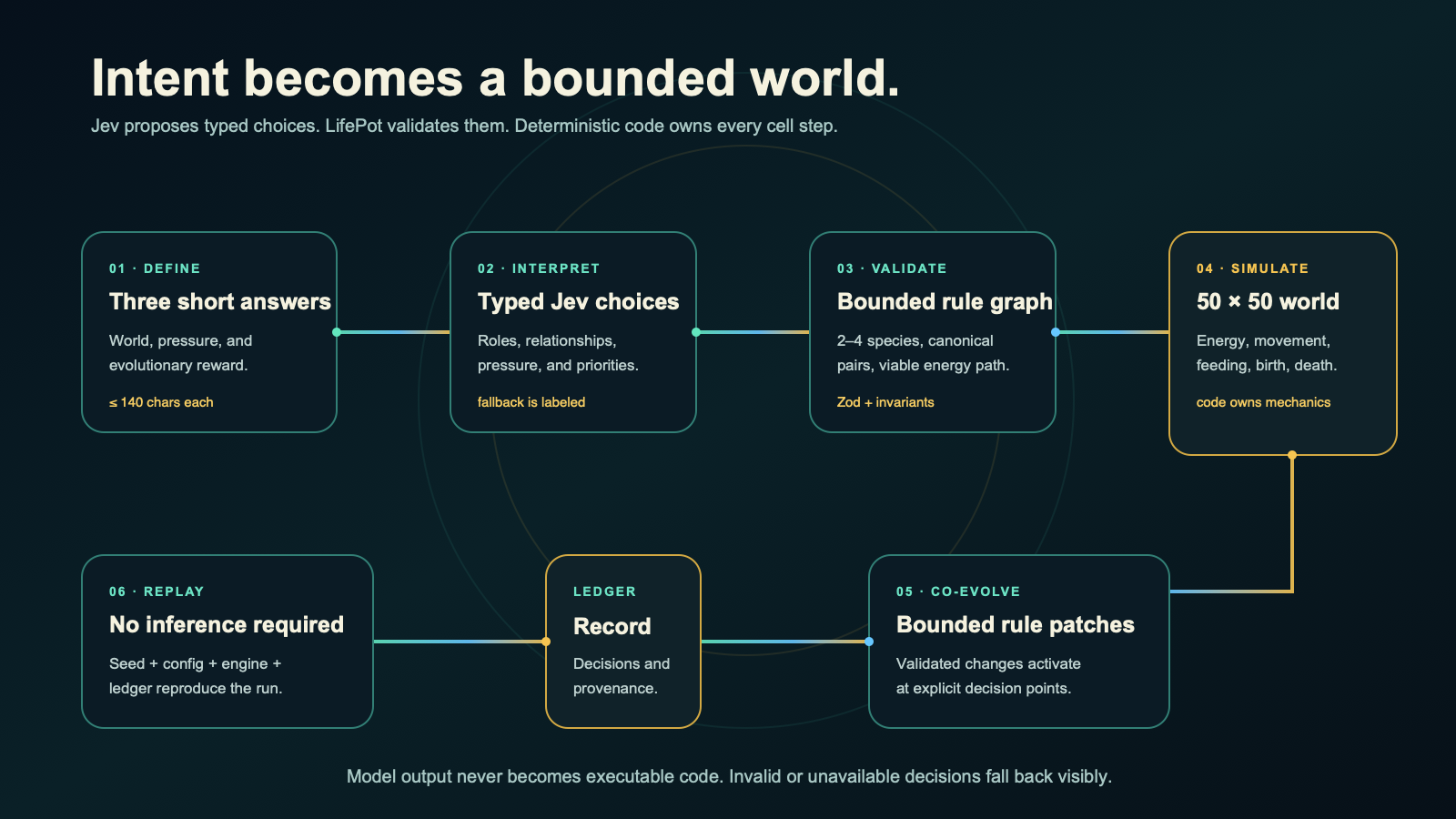
The editable source is assets/lifepot-architecture.svg.

Request path
1. The browser collects world, threat, and reward answers.
2. src/game/setup.ts canonicalizes them and derives the setup request hash.
3. src/app/api/judge/route.ts validates request size, shape, and quota before dispatch.
4. src/app/api/judge/service.ts asks Jev typed questions or returns a labeled deterministic fallback.
5. src/game/rules.ts validates the complete world-rule graph and its invariants.
6. src/game/world.ts creates and advances the seeded cellular world.
No response field is evaluated as source code.
Runtime ownership
| Area | Owner | Responsibility |
|---|---|---|
| Setup contract | src/game/setup.ts | Canonical answers, request/replay hashes, setup schemas, deterministic fallback |
| Rule graph | src/game/rules.ts | Finite vocabularies, graph invariants, rule patches, activation conditions |
| Model boundary | src/app/api/judge/ | HTTP schemas, TypeSafe client calls, fallback selection, quota enforcement |
| Ecological decisions | src/game/decisions.ts | Frozen observations, triggers, evidence schemas, fallback abstention |
| Runtime orchestration | src/game/runtime.ts | Trigger pauses, exact-decision binding, ledger ordering and cooldown |
| Simulation | src/game/world.ts | Cellular mechanics, deterministic random stream, graph execution, outcomes |
| Replay | src/game/replay.ts | Contract validation, encoding, tamper detection, inference-free playback |
| Interface | src/components/GameCanvas.tsx | Setup, world review, controls, visualization, and replay interaction |
World-rule graph
A graph contains:
- two to four canonical species slots (
AthroughD); - one trophic role and one self-interaction per species;
- every canonical pair exactly once;
- one environment rule set;
- a monotonically increasing graph version.
Validation also requires a viable basal-energy path. Scheduled patches can change one pair relationship, one species self-interaction, or one environment field. A patch is applied only when its bound trigger condition is due and its graph-version evidence matches.
Decision loop
detectEvolutionTrigger observes the deterministic world. It cannot trigger before generation 12, within 12 generations of the previous accepted decision, or after eight ledger entries.
At a trigger:
1. LifePot freezes and hashes the observation.
2. Jev proposes a typed decision. If inference is unavailable or rejected, the labeled runtime fallback abstains from new intervention.
3. Validation checks probability coverage, selected maxima, trigger, generation, observation hash, graph version, and scheduled-change evidence.
4. The accepted decision is appended to the ordered ledger.
5. Deterministic stepping resumes and applies only the bounded mechanics encoded by the decision.
Replay
Replay version 3 binds:
- the engine version;
- canonical setup answers;
- validated configuration;
- unsigned 32-bit seed;
- canonical setup hash;
- ordered evolution ledger;
- replay contract hash.
Validation runs the ledger through the engine. Missing, reordered, unreachable, mismatched, or modified decisions fail before a replay is accepted.
Failure behavior
- Missing API key: deterministic fallback.
- Invalid model response: deterministic fallback.
- Network or timeout failure: deterministic fallback.
- Invalid request: rejected before interpretation.
- Production without distributed quota configuration: fails closed to fallback.
- Invalid replay: rejected; no best-effort execution.
- Setup fidelity requests correction: one bounded, dependent roles-then-links repair and renewed fidelity review. Persistent disagreement offers a finite review focus with original answers retained. Failure during repair preserves the blocked proposal rather than bypassing its rejection through fallback.
Fallback output is always marked with source: "fallback" and is never presented as Jev evidence.