An artificial-life sandbox
Shape a world.
Watch life unfold.
Shape an ecosystem. Watch organisms feed, reproduce and change as life unfolds.
Recorded example · exact replay
The little pond.
Pause, inspect a creature, follow a family.
Explore this exampleLifePot in practice
Watch how it works
Follow one pond from its first organisms to its next experiment.
Silent · on-screen explanations · 2 min 48 sec
Open videoRead the demo transcript
0:00 Can grazers persist in this pond?
Your question becomes an inspectable experiment.
- Name organisms and who eats whom.
- Roles and feeding links are separate settings.
Start with a simple food web.
0:10 Choose the conditions.
Choose the conditions you want to explore.
- Resources supply energy for life.
- Supported pressures shape the starting conditions.
Change one thing you can explain.
0:19 Give the experiment a direction.
What would you like to investigate?
- A preference guides supported strategies.
- It does not guarantee the outcome.
Keep your prediction observable.
0:28 Check the world before it begins.
Review the actual settings, then play.
- Check roles, links and founder estimates.
- You choose when to seed the world.
Edit the interpretation before starting.
0:38 Learn to read the habitat.
Birth, feeding and death cues mark recorded events.
- Species colors distinguish populations.
- Green marks show resources; warm marks show hazard.
Pause when a change catches your attention.
0:50 Turn one creature into a closer look.
Inspection pauses the world.
- Read energy, age and living family.
- Keep the selected subject beside the habitat.
Zoom for detail; overview for patterns.
1:00 Why inspect inherited traits?
Recorded example close-up: inherited engine values.
- Fecundity shifts the energy needed to reproduce.
- Parents transfer energy to their offspring.
Trait values run from 0 to 255.
1:06 Fecundity changes the reproduction threshold.
Recorded example close-up: inherited engine values.
- Fecundity shifts the energy needed to reproduce.
- Parents transfer energy to their offspring.
Trait values run from 0 to 255.
1:12 Will this hunter family survive?
Follow descendants across generations.
- Gold marks identify the followed family.
- Camera-follow tracks its living members.
A family can grow, shrink or disappear.
1:24 See what this policy actually changes.
Shown: policies for future offspring.
- A offspring inherit a lower reproduction threshold.
- B offspring inherit more efficient resource feeding.
These policies do not rewrite every living creature.
1:36 The food web reaches an ending.
Every ending leaves evidence to investigate.
- Algae disappear at generation 43; grazers at 90.
- Hunters and the followed family are lost at 113.
Follow the losses in the species timeline.
1:46 Turn the result into another question.
The engine supplies the measured evidence.
- Jev selects facts from this run.
- Review its proposed next experiment.
Use a turning point to choose the next question.
1:56 Try more starting resources.
The next choice remains yours.
- Review the resource change before seeding.
- Keep the original run as the comparison baseline.
Keep the previous run for comparison.
2:06 Play the changed experiment.
This is a new experiment, not replay.
- Observe a new trial under changed conditions.
- Fresh adaptive decisions can also differ.
Compare the shapes of the population curves.
2:16 Did the changed world last longer?
Same seed, fresh adaptive decisions.
- Original world: empty at generation 113.
- Changed world: empty at generation 158.
This observation does not isolate a resource effect.
2:28 Keep a world worth investigating.
Keep the experiment you want to revisit.
- Save a recognizable world in this browser.
- Export a portable backup of its recording.
Browser-local saves do not automatically sync.
2:38 Choose a world. See what happens.
Play at lifepot.modepot.io
- Replay the recorded history without fresh inference.
- Change conditions to explore another possibility.
What would you investigate next?
HOW THE WORLD WORKS
Jev shapes conditions. Life unfolds.
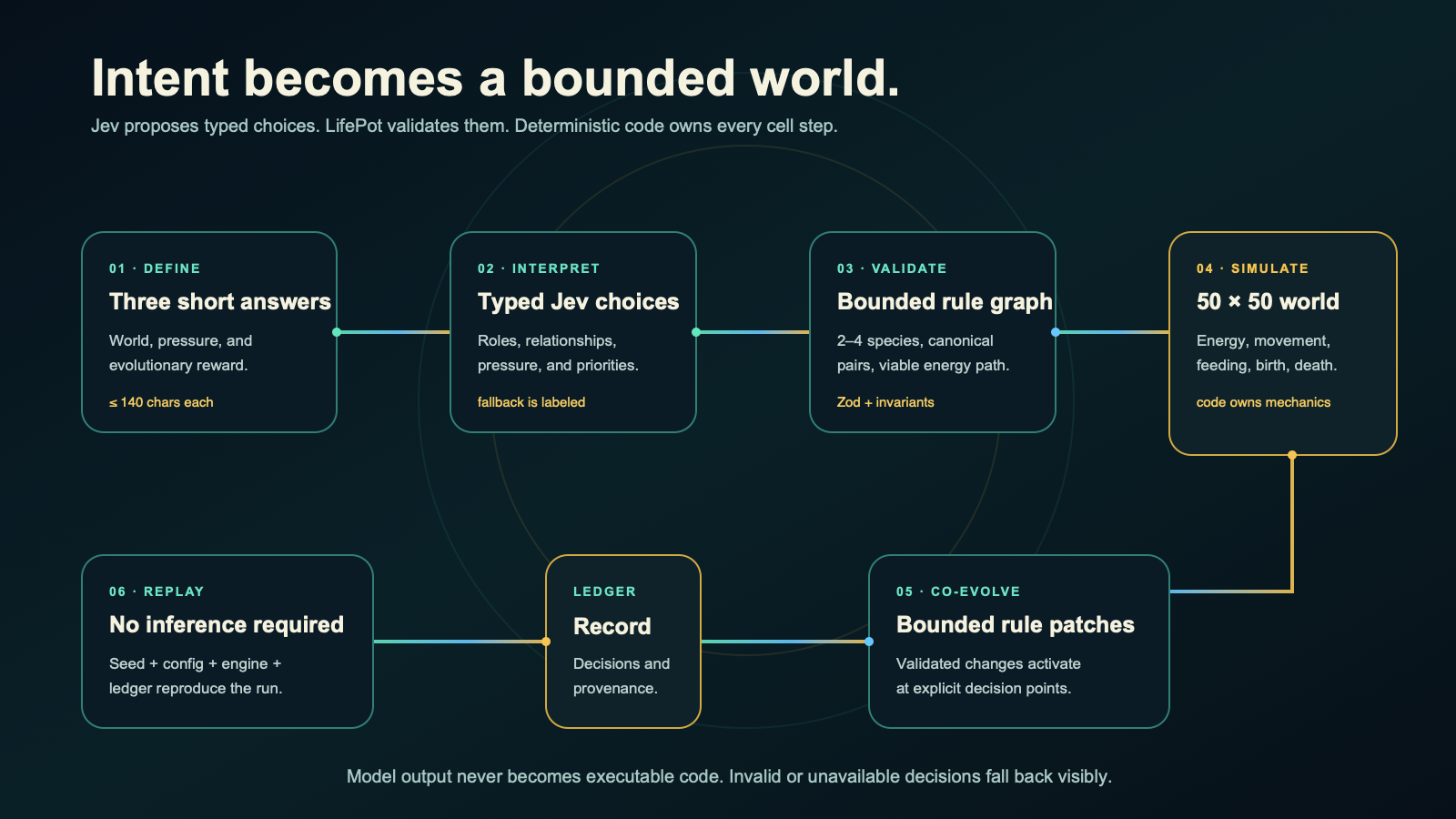
In adaptive worlds, Jev responds to the ecology with bounded changes to environmental conditions, species strategies and mutation policies—not direct control of individual organisms. LifePot validates those decisions; local simulation rules govern movement, feeding, reproduction and death.
Fixed-rule starters run without Jev decisions. Replay uses the same starting state and recorded decisions to reproduce what happened, rather than asking Jev to decide again. This is an experiment, not a biological forecast.
Play, observe, compare.
Inspect organisms and decisions, adjust supported conditions, then compare a new trial with a recorded replay. The guides explain the player flow, practical experiments, API boundaries and engine internals.
Explore the guides →