PUBLIC SOURCE DOCUMENT
Project README
Rendered directly from README.md at source revision 427d116110cd09f3938dd51b75baceb3d5920c1b. This page reflects that repository source; roadmap items are proposals, not shipped behavior.
LifePot
Part of ModePot. Project website Created by Tugrul Guner
Shape a world and watch life unfold. Organisms interact under local rules; in adaptive worlds, Jev responds to the ecology through bounded environmental changes and evolutionary policies.
An experimental artificial-life sandbox, not a biological forecast. Jev shapes supported world conditions and policies without directly assigning individual actions or guaranteeing survival. Inspect what happened and replay its recorded decisions.


Roadmap ·
Docs ·
Why LifePot
The goal is an artificial-life game where simple beginnings and relatively simple local rules can give rise to complex structures and behaviors. Explore how interactions, reproduction, inherited variation and changing environments affect what survives and reproduces, and what organization can develop over time. Players can create worlds, observe them and optionally shape supported conditions.
This is a development ambition, not a claim that the current engine demonstrates open-ended evolution. Mutation does not anticipate an organism's needs; selection depends on reproductive success in particular conditions. Greater complexity is not guaranteed. Social groups, culture and possible civilizations are longer-term research directions, not shipped capabilities or scripted levels. The roadmap separates these goals from demonstrated results and makes emergent organization and evolution first-class workstreams alongside gameplay and visual quality.
How the current game supports that investigation
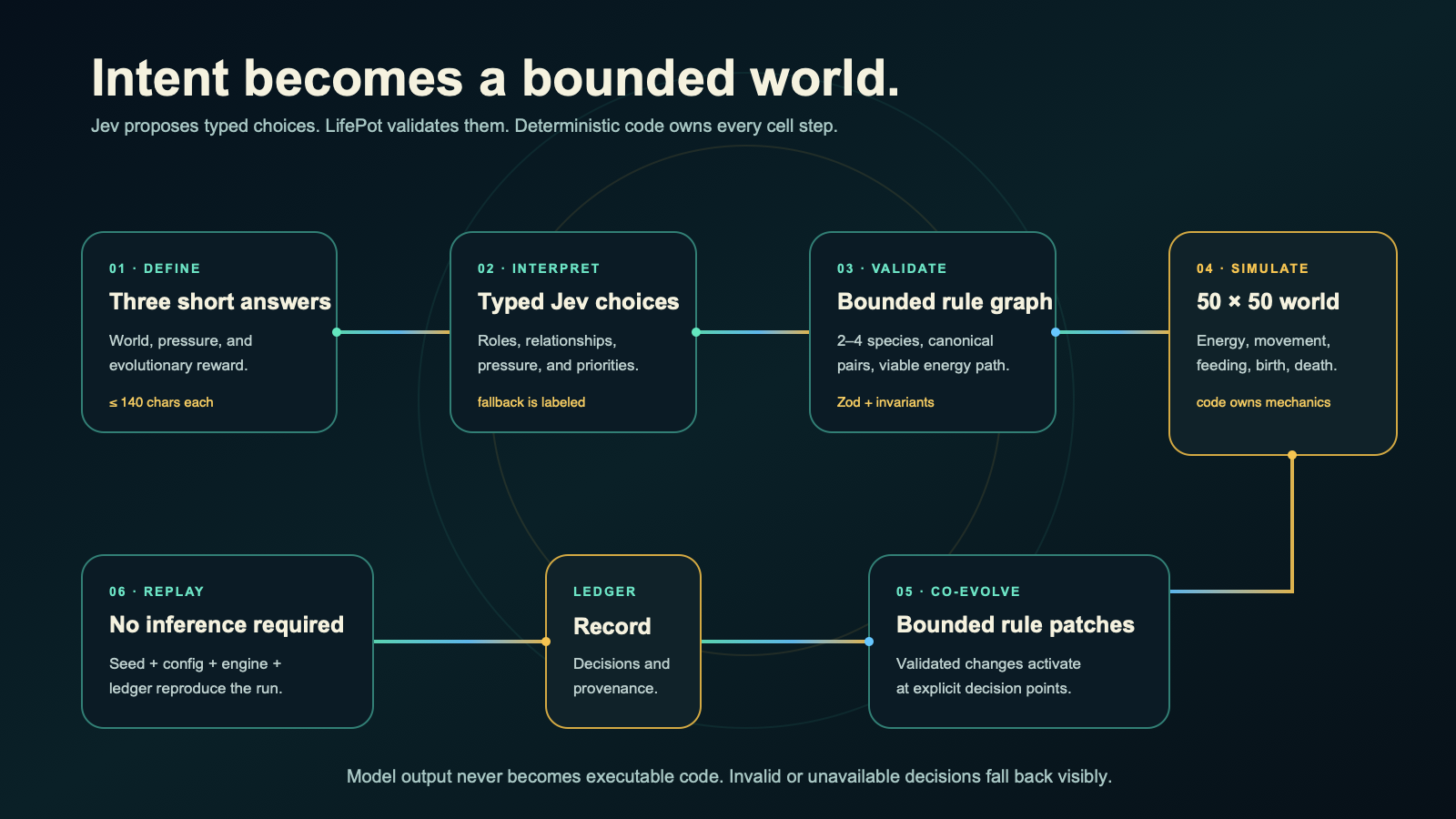
Most generative simulations either hard-code every world or let model prose quietly become behavior. In LifePot, model decisions become validated ecosystem rules—not executable code. LifePot separates the responsibilities:
- Jev proposes typed species roles, relationships, environmental conditions, strategies, and bounded rule changes.
- LifePot validates every proposal against finite schemas and ecosystem invariants.
- Deterministic code executes movement, feeding, resources, hazards, reproduction, mutation, death, and rule activation.
- The ledger preserves the decisions needed to inspect and replay a run without inference.
Adaptive does not mean arbitrary: Jev can select supported environmental pressures, species strategies, mutation targets and mutation tempos. The engine applies species directives at birth; Jev does not edit an individual cell, steer its movement or guarantee its survival. Fixed-rule starters make no setup or runtime model requests unless you explicitly select adaptive policy. When runtime inference is unavailable or rejected, the fallback abstains from new intervention.
Reproducibility is an engineering property, not the premise of the living world: the same configuration, seed, engine version and recorded decisions reproduce a run. A fresh adaptive run asks Jev for new decisions at supported ecological checkpoints; those decisions are not determined by the seed alone.
A world is not an arbitrary script. It is a validated graph:
{
  species: [
    { id: "A", role: "grazer", selfInteraction: "cooperative" },
    { id: "B", role: "hunter", selfInteraction: "territorial" },
  ],
  interactions: [{ pair: "A:B", mode: "b_consumes_a" }],
  environment: {
    regeneration: "steady",
    pressure: "stability",
    volatility: "stable",
    intensity: "medium",
    duration: "persistent",
  },
}
Try it locally
LifePot works without credentials through a labeled deterministic fallback. Add a TypeSafe API key to exercise live Jev interpretation.
git clone https://github.com/tugrulguner/lifepot.git
cd lifepot
npm ci
cp .env.example .env.local  # optional: add TYPESAFE_API_KEY
npm run dev -- --hostname 127.0.0.1
Open http://127.0.0.1:3000/play, answer three prompts, review the validated world, and seed the ecosystem. For local development only, LIFEPOT_SHOWCASE_MODE=1 enables the larger in-process model-call budget; bind to loopback (--hostname 127.0.0.1) and never expose showcase mode through a tunnel or public proxy. It is disabled in production and does not bypass production limits.
What ships today
- A deterministic, toroidal 50 × 50 cellular world that runs for at most 180 generations.
- Two to four rule species with canonical pair relationships and an explicit basal-energy viability check.
- Energy, resources, hazards, movement, trophic feeding, reproduction, death, lineages, strategies, and five bounded heritable traits.
- Triggered ecological decisions for prey crashes, predator crashes, resource shifts, speciation, predation spikes, and stagnation.
- Validated scheduled changes with explicit activation, duration, transition, and graph-version bindings.
- A deterministic fallback for absent credentials, invalid responses, network failures, and exhausted limits.
- Versioned replay data bound to the setup request, engine version, configuration, seed, decision ledger, and contract hash.
- World Observatory metrics, trends, species relationships, lineage history, and event timeline.
- Creature Inspector with cell facts, inherited traits, and lineage following.
- Setup/runtime council provenance recorded with decisions and replay; see the council contract.
- Unit, API/security, rule-engine, replay, and browser acceptance coverage.
How it works
1. Define the world
POST /api/judge accepts exactly three trimmed strings of at most 140 characters:
1. What exists in this world?
2. What threatens life here or how does it change?
3. What should life be rewarded for?
The request includes a canonical setup hash. Text remains data; it never becomes executable rules.
2. Interpret and validate
Jev answers typed Choice and Score questions. LifePot accepts only enumerated roles, interactions, environmental laws, strategies, mutation settings, and transition controls. Zod schemas and additional graph invariants reject incomplete, noncanonical, or unviable configurations.
3. Simulate in code
The seeded engine owns every cell step. It uses typed arrays for world state and applies graph relationships mechanically. A species label does not create feeding behavior; only the validated directed relationship does.
4. Co-evolve at bounded triggers
After generation 12, LifePot can pause on a canonical ecological trigger. Decisions have a 12-generation cooldown. Automatic decisions and accepted player changes share a maximum of eight records. A candidate automatic decision must match the frozen observation hash, generation, trigger, and current rule-graph version before it can affect the run.
During a new adaptive run, Ask Jev to change this world pauses observation and lets you request a supported temporary environmental pressure. Jev can decline unsupported requests; review its named choice before explicitly accepting it. An accepted change starts on the next generation, lasts six generations, then restores the previous pressure if the run continues. These are externally imposed player-authorized changes—not spontaneous biology or automatic council decisions. Overlapping changes, unchanged-pressure proposals, stale results and changes to recorded replays are rejected. Cancelling leaves the world paused and unchanged.
Player changes are retained separately in version 4 replays and browser-local world exports, with factual activation/restoration timing. The request text and optional private question are not included in those recordings. Supported version 3 recordings remain unchanged and replay without inference.
5. Replay without inference
Replay validates the complete contract before executing. The same accepted seed, setup, configuration, engine version, and ordered ledger reproduce the run without calling Jev. Modified, reordered, unreachable, or incomplete decisions are rejected.
Boundaries
LifePot is an artificial-life toy, not a biological forecast.
- Only the enumerated roles, relationships, pressures, strategies, and transitions exist.
- Model confidence is evidence about a typed choice, not proof of ecological truth.
- Mutation settings influence bounded mechanics; they do not imply foresight or beneficial evolution.
- Extinction is a valid result. Fallback behavior is labeled rather than presented as model output.
- Replay provides deterministic reproduction of this engine contract, not a scientific guarantee about nature.
Read the simulation contract for the exact boundary and the architecture guide for ownership across the system.
Documentation
| Guide | Purpose |
|---|---|
| --- | --- |
| Architecture | Request flow, module boundaries, validation, runtime, and replay |
| Simulation contract | Determinism, bounded semantics, guarantees, and non-guarantees |
| Deployment | Environment variables, distributed limits, and production checks |
| Reviewing | Correctness and safety checklist for changes |
| Roadmap | Direction without presenting planned work as shipped |
| Contributing | Setup, quality gates, and contribution scopes |
Development
npm test
npm run lint
npm run typecheck
npm run build
npx playwright install chromium
npm run test:e2e
The normal suite uses controlled fixtures. Passing fixtures validates contracts and orchestration, not live-model quality.
Community and contributing
Use GitHub Issues for reproducible bugs and scoped proposals. Use the permanent ModePot Discord for exploratory discussion and implementation questions.
Before opening a change, read CONTRIBUTING.md. Substantial simulation-contract or model-authority changes should be discussed before implementation.
ModePot family
LifePot is part of the ModePot family alongside Intpot, Summonpot, and Dexpot.